AKS MCP Server
The AKS extension registers a Model Context Protocol (MCP) server that gives Copilot Chat contextual access to your AKS clusters. The server is registered automatically — there is no setup command to run.
How to Use
- Open the Command Palette (
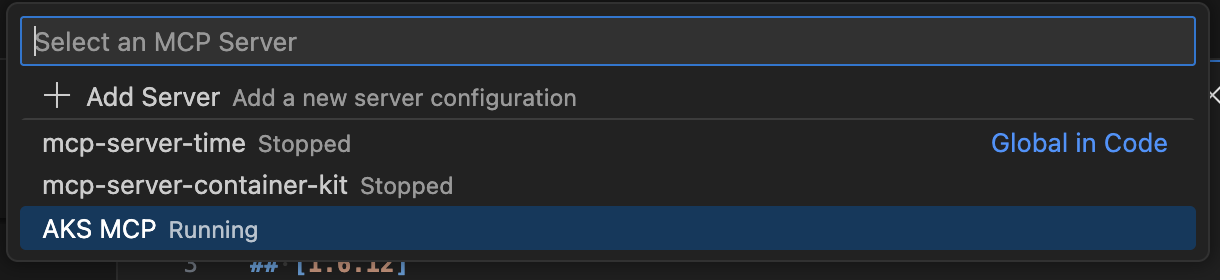
Cmd+Shift+Pon macOS /Ctrl+Shift+Pon Windows/Linux) and runMCP: List Servers. - Find AKS MCP in the list and start it. The first start downloads the server binary, and subsequent starts will use the stored copy.

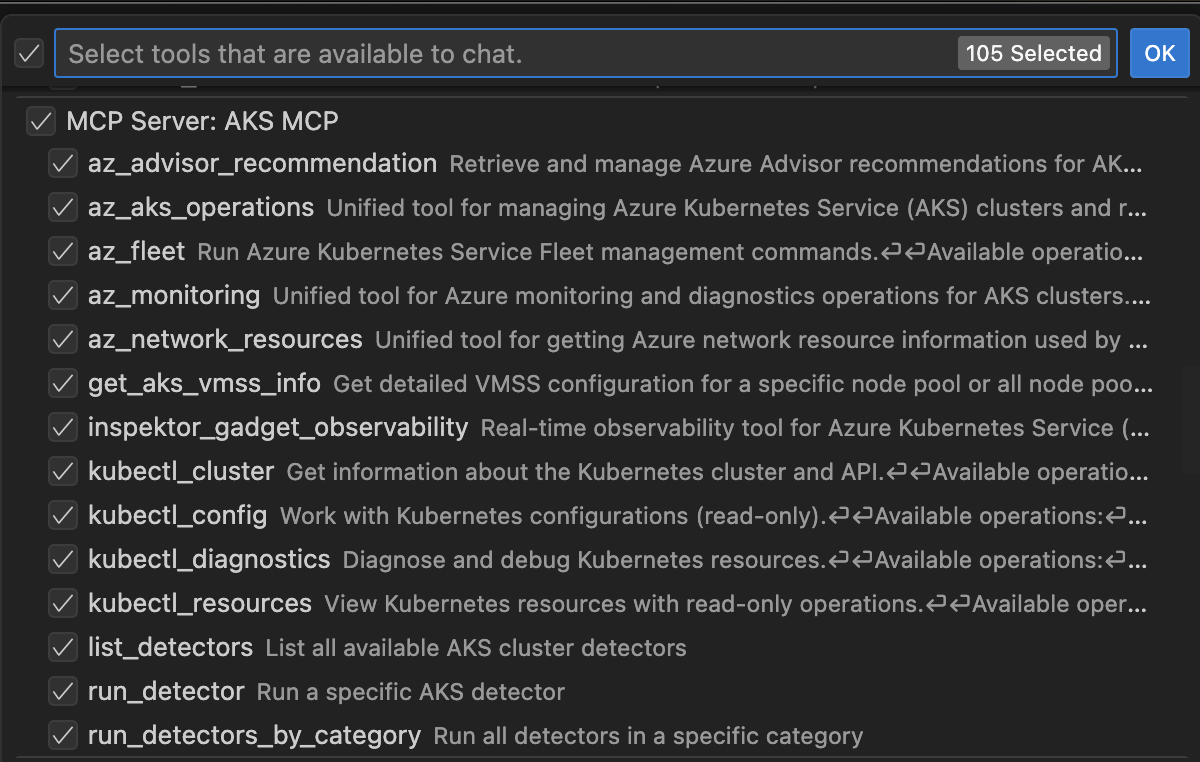
Once started, the AKS MCP server appears in the Copilot Chat: Configure Tools dropdown.

Remote development (WSL, Remote-SSH, Dev Containers)
The server registers itself in whichever extension host you’re connected to, and the binary downloads to that same machine on first usage. No additional setup is required.
Limiting Enabled Components
Some components require local CLI tools (e.g. helm, cilium, hubble). The default configuration enables az_cli, monitor, fleet, network, compute, detectors, advisor, inspektorgadget, and kubectl to ensure a comprehensive setup out of the box. You can change this by setting aks.aksmcpserver.enabledComponents in your VS Code user settings.
"aks.aksmcpserver.enabledComponents": "az_cli,kubectl,monitor,network"
Available components: az_cli, monitor, fleet, network, compute, detectors, advisor, inspektorgadget, kubectl, helm, cilium, hubble. Set to an empty string to enable all components.
Pinning the Server Version
The extension pins a specific aks-mcp release via the aks.aksmcpserver.releaseTag setting. Override it to test a different release. Binaries are cached at ~/.vs-kubernetes/tools/aks-mcp/<version>/; you can delete old versions manually if needed.
Troubleshooting
- If the server doesn’t appear in
MCP: List Servers, restart VS Code so the extension can re-register the provider. - If the server fails to start, open
MCP: List Servers, select AKS MCP, and choose Show Output to view the server log.