Enabling an additional Azure region doesn't require changing or duplicating the full platform footprint of an existing geographic hub. An organization can maintain a small number of strategic geographic hubs that provide resilient hybrid connectivity and common enterprise services. Other Azure regions can use a more efficient profile and consume capabilities from those hubs when workload requirements permit.
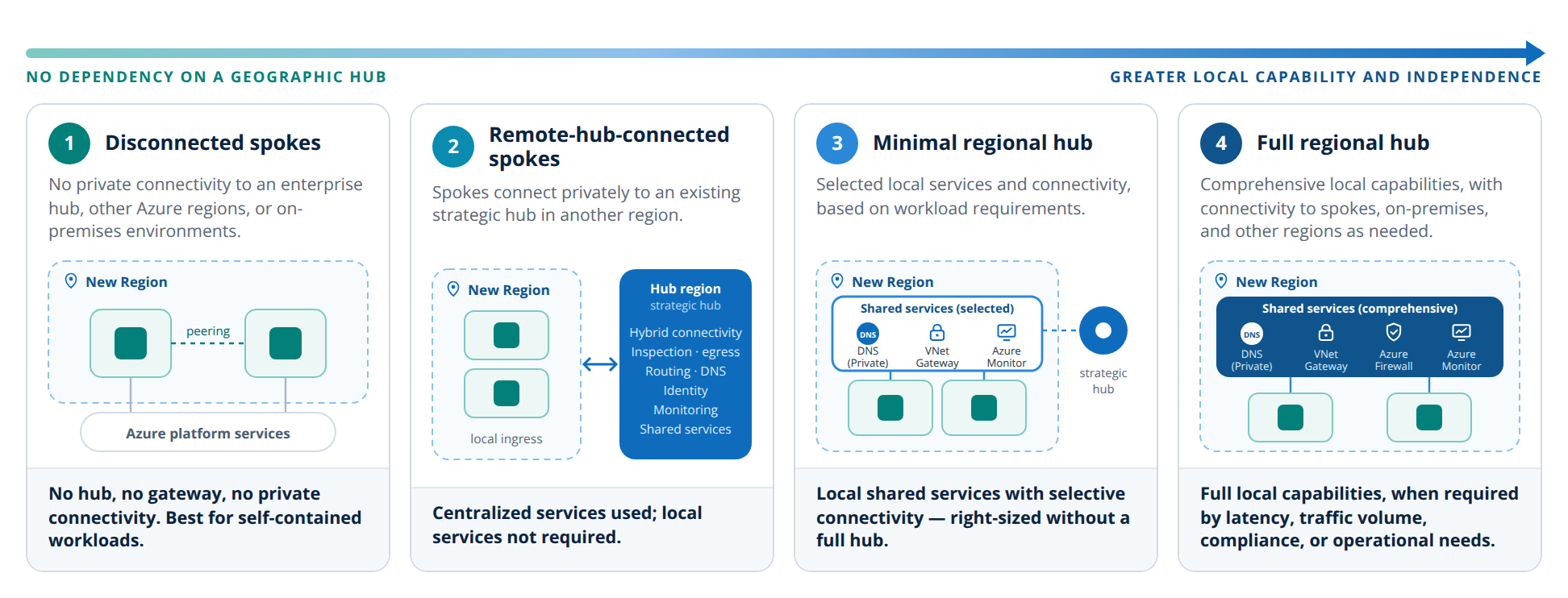
The four profiles form a spectrum: from Disconnected Spokes, with no dependency on a geographic hub, through Remote Hub Connected and Minimal Regional Hub, to a Full Regional Hub with greater local capability and independence. They aren't maturity stages. A profile can remain the right target for a region as long as it continues to satisfy workload and platform requirements.
Profiles describe platform capabilities, not workload designs; Workload Landing Zone archetypes describe what applications need.
Disconnected Spokes#
Workload spokes operate without private connectivity to an enterprise geographic hub, another Azure region, or an on-premises environment. They can still use direct connectivity to other spokes where required and approved private or public connectivity to Azure platform services.
Workloads can operate without private connectivity to an enterprise geographic hub, another Azure region, or an on-premises environment, and their required platform services can be consumed locally or through approved Azure service connectivity. This can include self-contained cloud-native, AI, development, test, batch, HPC, VDI, or internet-facing workloads where those conditions are met.
Workload resources plus the controls needed to deploy, secure, monitor, and operate them. These spokes still use the estate's standard identity, policy, security, and deployment practices.
Remote Hub Connected#
Workload spokes in the additional region use cross-region connectivity to access an existing strategic geographic hub. The geographic hub can provide hybrid connectivity, security inspection, internet egress, routing, DNS, identity, monitoring, or other shared services without requiring a complete hub to be deployed locally.
Cross-region connectivity can be implemented through appropriate Azure networking capabilities based on the required topology and routing model. Public application ingress can remain local through services such as Azure Front Door or Application Gateway when appropriate.
Workloads require private access to selected enterprise or on-premises services but can tolerate the latency, availability coupling, data-transfer implications, and dependency on connectivity to another region.
Workload spokes and any capabilities that must remain close to the workloads. Gateways, firewalls, hybrid connectivity, routing services, and selected shared services can remain in an existing geographic hub when workload requirements permit.
Minimal Regional Hub#
The additional region includes a limited hub footprint that provides selected local connectivity and shared services while continuing to consume other capabilities from an existing geographic hub.
The Minimal Regional Hub provides only the local capabilities required by its workloads rather than replicating a complete platform footprint. Depending on workload requirements, these capabilities can include east-west routing, DNS, monitoring, backup, security inspection, egress, private connectivity, selected identity or directory services, on-premises connectivity, or other services that must remain close to the workloads.
Workloads require some local shared services, application-to-application connectivity, lower-latency dependency paths, regional security controls, or greater independence than a Remote Hub Connected profile can provide.
A regional hub containing only the connectivity and shared-service capabilities that must operate locally. Hybrid connectivity, specialized networking functions, central management, and other services can remain in a strategic geographic hub when appropriate.
Full Regional Hub#
The region provides the complete set of local connectivity and shared services required for its designated workloads and geographic responsibilities. Depending on those requirements, this can include local hybrid connectivity, security inspection, routing, internet ingress and egress, DNS, identity services, monitoring, backup, key management, and other required platform capabilities.
A Full Regional Hub uses the same operating model and control baselines as other strategic hubs. It does not have to be an identical copy; its capabilities should reflect the workloads and geography it supports.
Workload and platform requirements justify a comprehensive local capability set—for example, where the region requires local hybrid connectivity, substantial local shared services, strict latency or data-boundary controls, significant interconnected application portfolios, or sufficient independence to continue operating when another region or geographic hub is unavailable.
The approved set of local connectivity, shared services, operational capabilities, and independent critical paths required by the region's workload portfolio.