Preparing Azure App Service and Azure Functions TLS for post-quantum cryptography
Azure App Service and Azure Functions are beginning a phased rollout of support
for the TLS 1.3 hybrid key exchange group X25519MLKEM768.
This update helps prepare applications for a post-quantum future without requiring you to change your application code or platform configuration. The rollout will expand progressively across App Service infrastructure in public Azure later this year.
Why post-quantum key exchange matters
Today’s commonly used public-key algorithms could eventually be vulnerable to cryptographically relevant quantum computers. Although such systems are not available today, encrypted traffic collected now could potentially be retained and decrypted in the future. This is commonly described as a harvest-now, decrypt-later threat.
Post-quantum cryptography uses algorithms designed to resist attacks from both classical and quantum computers. Introducing these algorithms into TLS key exchange is an important step toward protecting the long-term confidentiality of inbound client traffic and advancing Microsoft’s broader quantum-safe security strategy.
How hybrid key exchange works
X25519MLKEM768 combines two key-establishment mechanisms:
- X25519, a widely deployed classical elliptic-curve algorithm.
- ML-KEM-768, a post-quantum key encapsulation mechanism standardized by NIST.
Using a hybrid group provides defense in depth during the transition to post-quantum cryptography. The TLS connection derives its key material from both the classical and post-quantum mechanisms rather than depending only on a new algorithm.
X25519MLKEM768 is a TLS supported group for key exchange. It is not a TLS
cipher suite, and this rollout does not change the App Service minimum TLS
cipher-suite configuration. Microsoft documents this and other post-quantum
hybrid groups in the
Windows TLS supported-groups reference.
What this means for your applications
When both the client and the App Service front end support TLS 1.3 and
X25519MLKEM768, they can automatically negotiate the hybrid key exchange
during the TLS handshake.
Clients that do not support the hybrid group will continue to negotiate an existing classical key exchange. This fallback helps preserve compatibility with browsers, application frameworks, SDKs, proxies, and other clients while post-quantum support becomes more widely available.
Scope of protection
This initial rollout applies to inbound TLS connections for Azure App Service Web Apps and Azure Functions apps hosted on App Service infrastructure in public Azure. It covers Windows and Linux apps across all App Service and Azure Functions hosting plans that use this infrastructure.
Azure Functions on Azure Container Apps are not included in this rollout because they use Azure Container Apps ingress rather than the App Service front-end infrastructure.
App Service terminates the client connection at the front end. When end-to-end
TLS encryption is enabled, App Service establishes a separate TLS connection
between the front end and the worker running the application. Each connection
negotiates TLS independently, so negotiation of X25519MLKEM768 on the client
connection does not mean that the front-end-to-worker connection uses the same
hybrid key exchange.
End-to-end TLS encryption remains available and continues to protect traffic between the front end and worker. Post-quantum key exchange for that internal connection is outside the scope of this initial rollout.
What you need to know
This is a platform-managed update. You do not need to:
- Modify or redeploy your applications.
- Add an App Service application setting.
- Change your minimum TLS version or cipher-suite configuration.
- Obtain a post-quantum certificate.
Hybrid post-quantum key exchange does not change certificate requirements or bindings.
Client platforms will use the hybrid group automatically when they support it and it is available on the App Service front end handling the connection.
The initial release uses platform-managed, opportunistic negotiation. There is no customer setting to enable or require the hybrid group, and minimum TLS or cipher-suite settings do not control it. Setting the minimum TLS version to 1.3 does not require post-quantum key exchange: TLS 1.3 clients that support only classical key exchange can still connect.
Performance and compatibility
Hybrid post-quantum key exchange exchanges more data and requires additional cryptographic work when establishing a new TLS connection. Microsoft testing found the expected increase in TLS handshake time.
Applications and clients that reuse established TLS connections do not repeat the key exchange for every HTTP request.
Microsoft will monitor negotiation, fallback, latency, connection failures, and rollout coverage, expanding deployment as validation criteria are met.
Rollout
The capability will roll out progressively to Azure App Service Web Apps and Azure Functions apps in public Azure later this year. During the rollout, availability may vary by region and by the front end serving a connection.
No action is required if a compatible client does not immediately negotiate
X25519MLKEM768. Classical TLS key exchange will remain available throughout
the rollout.
See hybrid post-quantum TLS in action
The following example connects to a Linux Web App running a small .NET probe.
First, an HTTPS request identifies the application and its operating system.
Then, an OpenSSL client offers only X25519MLKEM768 to verify hybrid key
exchange with the App Service front end.
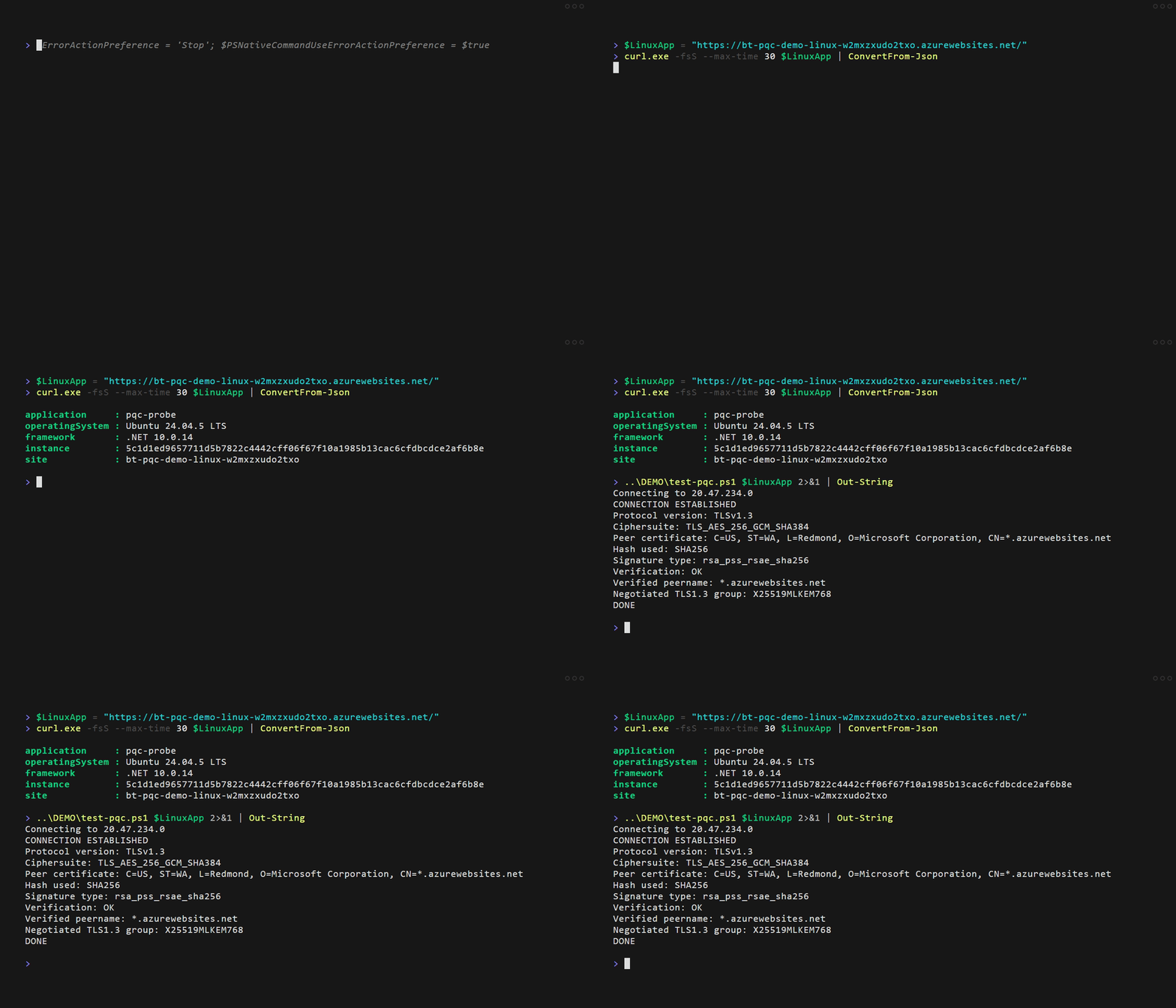
To test your own app from PowerShell, use an OpenSSL client on PATH
with support for X25519MLKEM768 and a trusted certificate chain.
Replace <your-app-hostname> with your app’s hostname, without https://
or a path:
$appHost = '<your-app-hostname>'
'' | openssl s_client -connect "${appHost}:443" -servername $appHost `
    -tls1_3 -groups X25519MLKEM768 -brief -no_ign_eof `
    -verify_hostname $appHost -verify_return_error
A successful handshake includes:
Protocol version: TLSv1.3
Verification: OK
Negotiated TLS1.3 group: X25519MLKEM768
This test deliberately offers only the hybrid group. It will fail if the client or serving front end does not support that group. Unlike normal client negotiation, this test does not allow classical fallback.
