Cloud-native AI infrastructure for GPU workloads on Kubernetes
TauGrid brings the tau CLI, Kueue queueing, KubeRay
orchestration, GPU-node health monitoring, and observability into one
stack, spanning data preparation, distributed training, fine-tuning,
and inference. Platform teams get an integrated foundation; researchers
focus on their code, not Kubernetes plumbing.
One stack, different jobs to be done
Task-oriented paths keep platform bootstrap separate from researcher day-to-day workflows.
Platform engineers stand up and govern the stack
Deploy Kueue, KubeRay, GPU monitoring, and observability, then provide identity, queue, and storage policy.
Platform admin guide →Researchers run and compare experiments
Connect a repository, submit a smoke test or training run, inspect progress, and preserve results.
Developer guide →Operators find the first blocked layer
Separate config resolution, Kueue admission, scheduling, GPU health, and model progress.
Troubleshoot a run →Contributors extend portable capabilities
Choose the owning package, preserve compatibility, and prove the external contract.
Make a compatible change →From submission to healthy GPUs
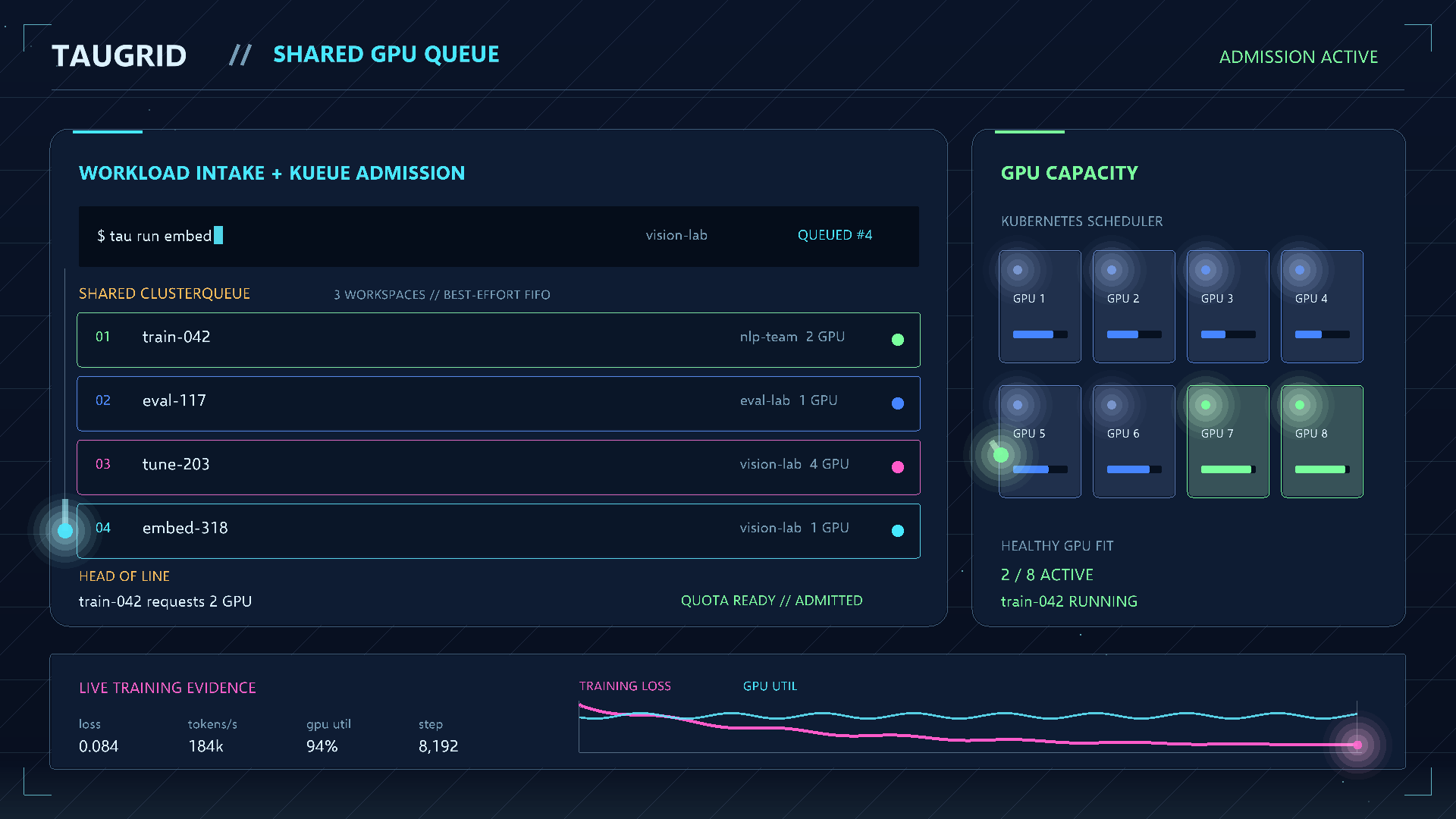
A workload submitted with tau run enters a shared Kueue ClusterQueue, receives quota, and is placed by Kubernetes on healthy GPUs. Queue state, placement, and live training evidence stay visible along the way.
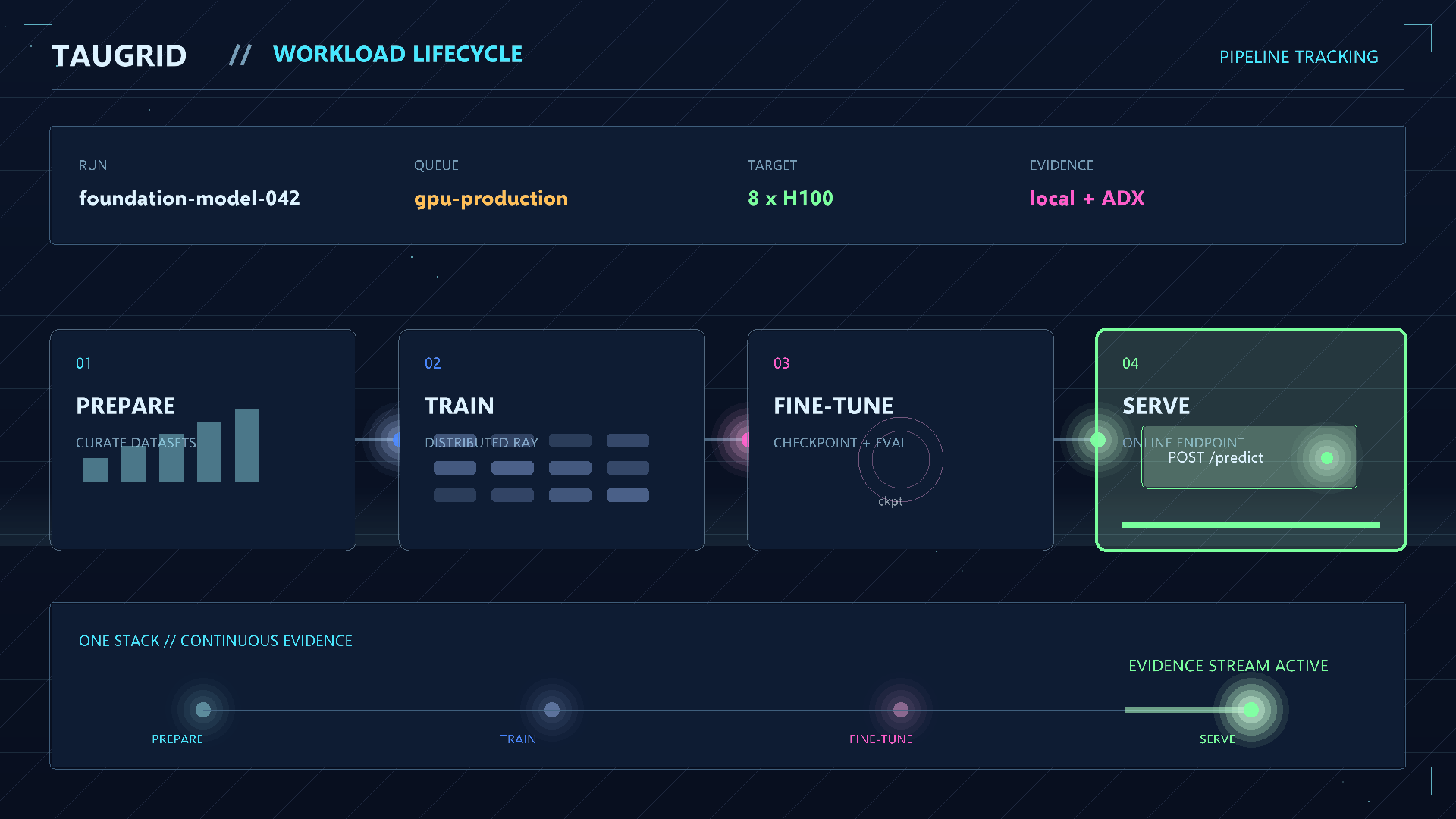
Across the GPU workload lifecycle
The same stack carries a workload from raw data through to a running endpoint.
Clear ownership from cluster to code
TauGrid packages the components needed to admit, run, and observe GPU workloads. Platform teams still operate clusters and capacity; researchers still own workload configuration and model code.
Deploy the GPU workload stack together
Install and upgrade Kueue, KubeRay, GPU health monitoring, and observability as one stack instead of maintaining the integration glue yourself.
Keep workload configuration with the code
Check run settings into the repository, resolve and validate them locally, then submit the rendered workload to Kueue and Kubernetes.
Capture evidence where the run happens
Record experiments, checkpoints, and artifacts locally by default, with optional scalar metric export to ADX.
Built in the open
TauGrid is MIT-licensed and developed in the open on GitHub and Discord.